
I have previously written about how, for all the negativity the town sometimes receives about being a ‘concrete jungle’, Crawley actually contains one of the highest levels of urban green space in the country. In fact, our level of ubran green space is five times the national average.
What might come of more of a surprise is that despite being a largely urban area, our level of woodland cover is also one of the best in England. In total, 13.9% (302 hectares) of Crawley’s surface area currently has tree coverage, which puts us 53rd out of 314 local authority areas.
This data was pulled together through research by Friends of the Earth, the purpose of which was to identify the potential for increasing woodland in the UK, with average coverage currently being a third of what it is in the EU. In addition to auditing exiting coverage they have made recommendations as to where new tree cover could be provided, with a potential 6.7 hectares identified within Crawley.
I have long wanted to see an increase in tree cover within the borough, but as we are a predominently urban area, I did wonder exactly where they were proposing to locate the tree coverage.
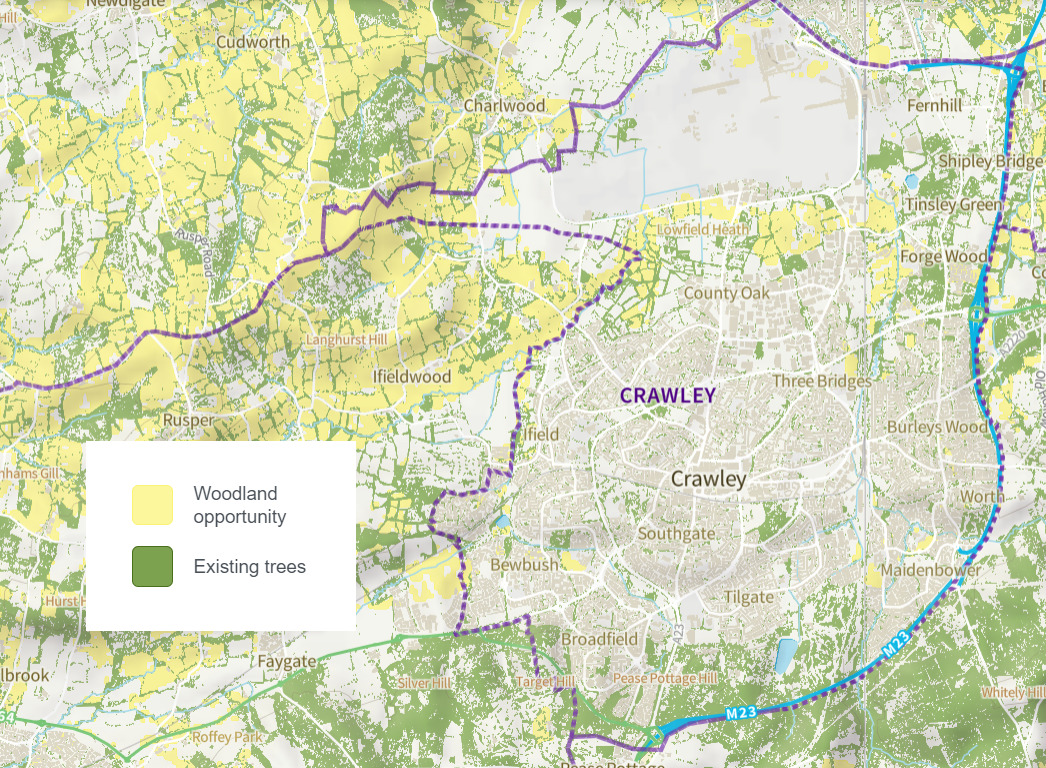
Judging from the map, the vast majority of the proposed land is in the safeguarded area adjacent to Gatwick, most of which currently forms farmland. Now, farmland does generally have low biodiversity, so putting aside questions of ownership, challenges facing global food production and potential ground radar issues, I guess that in principle it would be an environmental benefit to replace farmland with forest.
More of a problem are the ‘woodland opportunity’ sites located within the urban part of the borough.

As you can see, while there are small sites here and there, the largest locations proposed are school playing fields. I do wonder how they have been identified while local parks haven’t, but there is a lack of detail as to the methodology involved. At the end of the day, these sites have an important use and sadly really aren’t suitable for providing new tree cover.
However, it does seem to me that there are locations where greater tree coverage would not only be welcome in and of itself, but have added benefits.
Over recent years, West Sussex Highways have increasingly been removing trees along the town’s major avenues. From a financial perspective that makes sense at a time when councils are struggling with their budgets, as trees adjacent to roads require active management.
Yet, trees not only help to reduce levels of carbon dioxide, but there is increasing evidence that they reduce nitrous oxide levels, potentially helping to address the town’s air quality issues. Perhaps it is no concidence that the Air Quality Management Area along Crawley Avenue came into effect shortly after the county council had removed a large number of trees along the route.
Of course, turning that around will come at great cost and I suspect that this will take more than a donate a tree scheme. So long as budgets are so tight that even basic road maintenance is no longer an option, it is hard to see tree coverage improving any time soon.
Discover more from Peter Lamb for Crawley
Subscribe to get the latest posts sent to your email.
 Peter Lamb for Crawley