
The House of Commons Library has recently released a data dashboard breaking down data around GP and patient numbers by constituency.

It highlights that the biggest mismatch between doctors and patients is most heavily concentrated in the UK’s geographical South East. To some extent this isn’t a surprise. As a general rule population density in the UK declines the further you get from central London, but even in a very low population density area there is a limit as to how far you can expect people to travel to access a doctor. Consequently, low population density areas will also tend to have a better GP to patient ratio.
What is somewhat surprising is that despite having similarly high population densities to adjacent areas both South West London and Surrey have a lower patient to GP ratio than their neighbours. The most obvious difference which comes to mind is that these locations tend to be wealthier than their neighbours, so perhaps the desire for GPs to base themselves in those areas is greater or there are greater obstacles to things which might affect the GP to patient ratio.
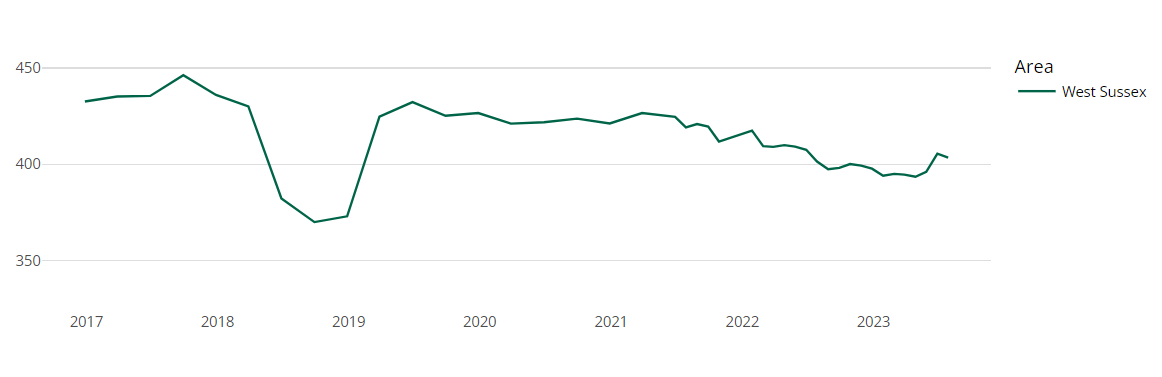
While I’m typically a fan of the HOC Library’s reports, as the number of my posts inspired by their work shows, the usefulness of this dashboard is hampered by the limited range of years for which the data is provided.
To be fair, the main reason for this is that the never ending process of NHS restructures results in the data being collected on different footprints over time. Depite this, in the case of West Sussex at least, there’s no reason they could not have combined the data from the CCGs to get a figure for West Sussex, and prior to the 2012 Health and Social Care Act the reporting unit for our area would have been the West Sussex Primary Care Trust.
Fortunately, this data remains publicly available if you know where to look. In the last year of Labour Government, West Sussex had 462 full-time equivalent (FTE) fully-qualified GPs compared to 403 today, a 13% cut in GP numbers.
At the same time, patient numbers in West Sussex have grown by 9%. The end result is that we have gone from having one FTE fully-qualified GP for every 1,769 residents to having one GP for every 2,316 residents, an increase in patient numbers for every GP of a third since the Conservatives came to office. Even without the demand-pressures of an ageing population, with figures like that it should be easy for everyone to see why NHS primary care is now currently fighting for its life.
Discover more from Peter Lamb for Crawley
Subscribe to get the latest posts sent to your email.
 Peter Lamb for Crawley