I joined the Labour Party while I was still a student at Holy Trinity, having come to feel a deep sense of injustice at how many of my school friends would ultimately find their futures capped by the fortunes of their parents rather than their own potential.
One of the first things I did when I became Leader of Crawley Borough Council was to visit local schools, businesses, and the college as part of work to develop the town’s first ever Employment and Skills Plan to try to improve career prospects in Crawley. While anecdotal, one thing which came out strongly from this research was the belief that Crawley had a big problem with social mobility.
Yet, it was only with the formation of the Social Mobility Commission that a general method for assessing mobility across the UK was produced, enabling the scale of the impact to be assessed and compared against other towns. When the results were published in 2017, out of around 350 local authority areas in the country, Crawley was ranked 21st social immobility, the worst in the entire South East.
While I questioned some parts of their methodology, the conclusion ultimately rang true and we set up a social mobility scrutiny panel at the council to both look into the issue and produce local recommendations. Following on from this work, we implemented what we could, but unfortunately there is a limit on what a district-tier authority with a budget for services of £15m can do to resolve issues with national education, social security, and economic policy.
Adding to the challenge facing Crawley is that in addition to the underlying issues creating social immobility, our location within one of the UK’s most prosporous sub-regions makes it easy for decision-makers at the national and county-level to either overlook our issues or simply ignore them in preference for a strategy in better keeping with the norm for the area.
It may be some time before Crawley is able to secure independence from the county council and gain greater local control over these policy areas, but I hope that after the next General Election we will have an MP willing to focus on issues important to the town rather than trivia, and for now the most important thing is that awareness of Crawley’s social immobility is raised with decision-makers…which is where we run into an issue.
It would appear that the Social Mobility Commission is no longer assessing mobility on a district-level, but has instead opted for 41 much larger geographical units, meaning that instead of getting figures for ‘Crawley’ we are now assessed as being part of ‘Surrey, East Sussex, and West Sussex’. Who wants to guess what that has done to our social mobility ranking? If you guessed ‘on paper it has turned us from being one of the lowest-ranked areas in the country to one of the highest’, you would be right.
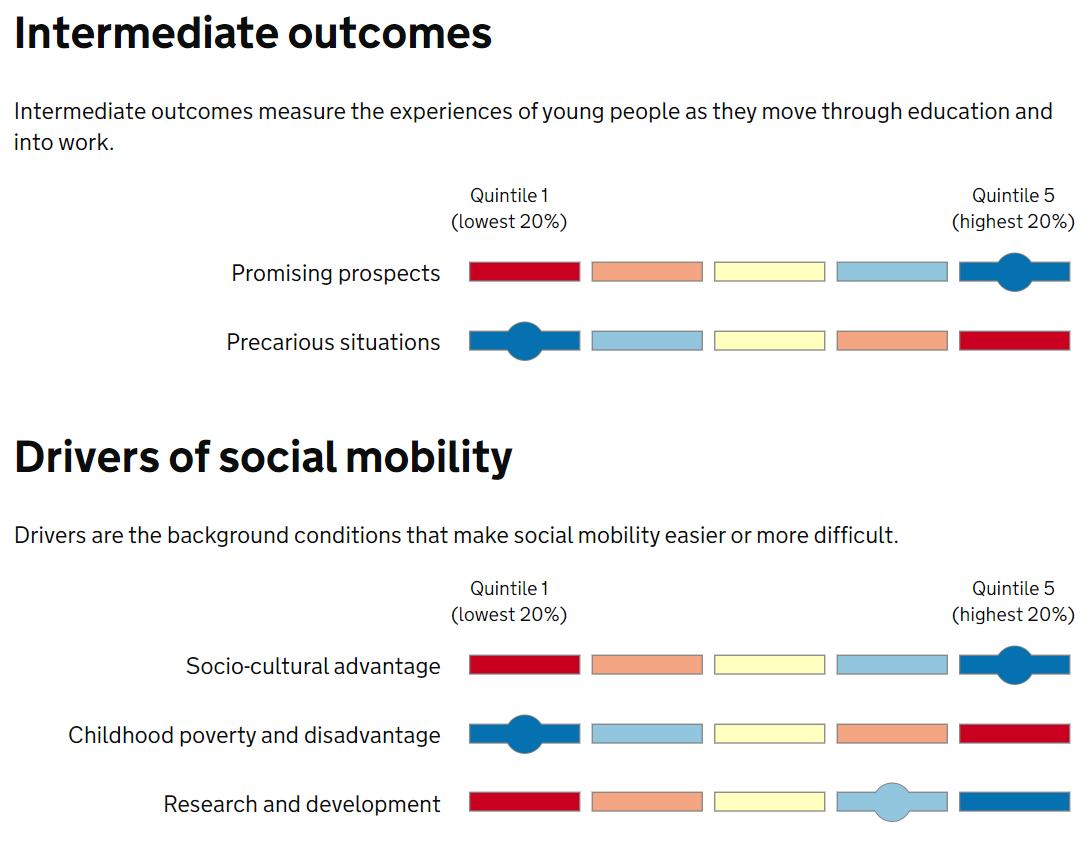
It is hard to overstate just how unhelpful this is. These figures aren’t just produced for general interest, they influence the decisions taken by the Treasury and other departments around funding and other forms of government support. It is a problem Crawley has faced time and time again in dealing with this Government.
Despite the official figures no longer giving us a national ranking for Crawley, Onward–a thinktank set up by the moderate wing of the Conservative Party–has produced a ranking for the 2023 using a similar methodology. Which confirms that Crawley has not suddently become one of the best performing areas in the country for social mobility, in fact we have now slumped to becoming the 16th most immobile.

Ultimately, better ranking systems alone won’t fix social mobility, nor will one-off pots of funding, there are various social, cultural and economic factors at play. Yet, without such systems it is very hard to see how we can secure the support and the changes which are necessary to end the fundamental injustice which is social immobility.
Discover more from Peter Lamb for Crawley
Subscribe to get the latest posts sent to your email.
 Peter Lamb for Crawley
1 Comment