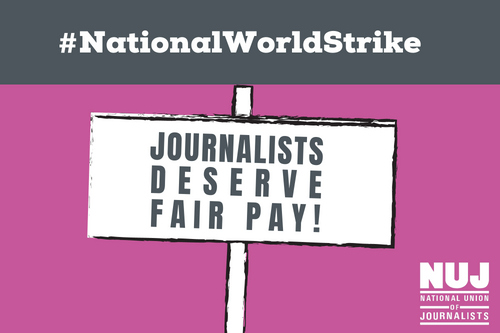
Today is the third day of a planned three days of strike action by journalists working for National World titles. Like many of the companies which play a regular role in our lives, the name of the business may seem much more unfamiliar than those of its subsidiaries, which in National World’s case includes our very own Crawley Observer.
Print media has been struggling for decades as the rise of internet advertising, and particularly the growth of the industry on Google and Facebook, has absorbed much of the revenue which once kept periodicals running.
At the same time, publishers have been unable to increase the price of their publications due to being undercut, with social media has increasingly sharing their content for free on their platforms (Meta’s recently-ended Community News Project was presumably motivated in part to try and undo some of this damage) and the internet enabling an almost limitless volume of amateur journalism to be self-published daily.
In response, newspapers have looked for alternative sources of revenue, closed titles, merged others, and relied on increasingly small and exhausted groups of reporters to generate content across a range of different titles.
So, while I do sympathise that for publishers there have been and continue to be difficult decisions, the reality is that it is their journalists who with every restructure and expansion in the nature of the work (such as the increasing volume of video content) who are the ones who ultimately do the heavy lifting.
Which is what brings us to the strike. Alongside voluntary and involuntary redundancies, the salary offer from National World is set to see journalists suffer a significant real-terms cut in their pay at the same time as they are being asked to take on the jobs of those who are leaving. This is clearly unfair and the justification for it is questionable when the company is making payouts to shareholders.
In my final column as Leader of Crawley Borough Council, I described local newspapers as an ‘immensely import public asset’. They are. A local newspaper helps bind a community together, it gives people the chance to know what is going on in their area and why, and–perhaps most importantly–it holds local decision-makers to account.
In the 520 times I have featured in the Crawley Observer over the years, there have been stories I have appeared in which I have liked and stories I appeared in which I really didn’t. Yet, in all that time, I have never once resented a headline when the story was newsworthy, no matter how hard for me it might have been at the time or if I disagreed with the editorial line being taken.
Why? Because people have a right to know what is going on in their community. Yet, for effective and well-informed journalism you need trained professionals, with the time to ask the questions which need to be asked and to delve into the depths of a story. It is a core pillar of our democracy. There is no substitute. That is what is now at stake.
If you would like to support quality local journalism, the National World chapel of the National Union of Journalists are running a petition in support of their cause: https://www.megaphone.org.uk/petitions/national-world-journalists-deserve-a-fair-pay-rise
Details about their strike hardship fund can also be found on the NUJ website here: https://www.nuj.org.uk/resource/national-world-strike.html
Discover more from Peter Lamb for Crawley
Subscribe to get the latest posts sent to your email.
 Peter Lamb for Crawley