Given how party political the Conservatives have managed to make the issue of breathing non-toxic air, I should probably start by saying that no one at any level has suggested that ULEZ should be expanded out to Crawley or that a local equivalent should be introduced by West Sussex County Council (although, given the level of public debate, you may well be surprised just how few people it actually affects). That suggestion falls into one of a very long things our current MP has said which have no actual basis in reality.
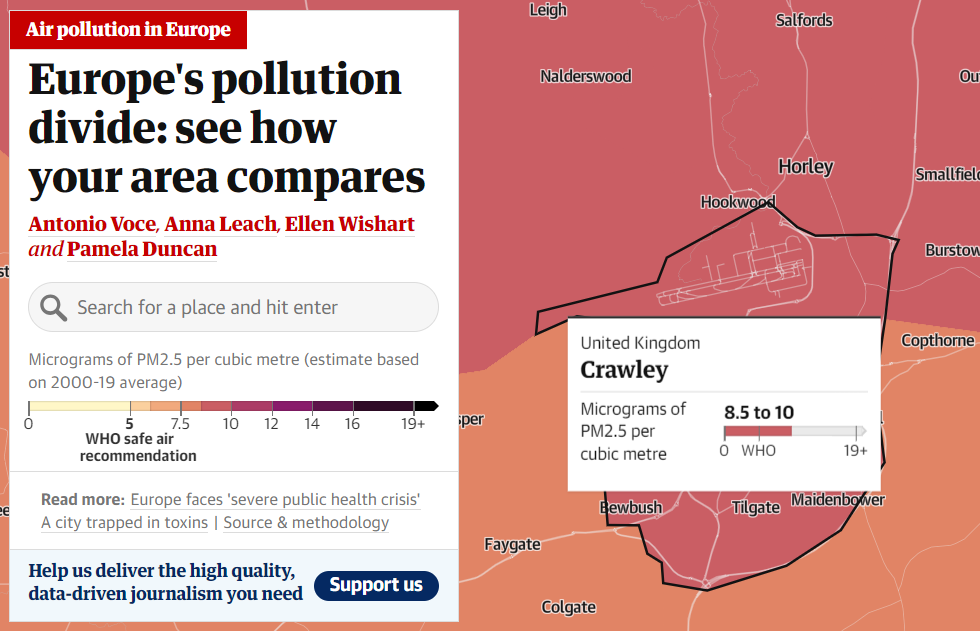
That being said, the first step to resolving a problem is acknowledging it and air quality in Crawley is pretty dire. The borough wide-average of particulate matter ranges from 8.5 to 10 micrograms by cubic meter, compared to the maximum safe limit of 5mcg/m3 assessed by the World Health Organisation.
That’s not great. Pollution is at such a level in the UK that coronors have started issuing verdicts of people being killed by poor air quality and the risk of stroke, dementia, cancer, longer-term illness including respiratory and cardiovascular disease, and early death have been proven to all increase as air quality declines.
Despite this, the average for Crawley still falls within roughly the same pollution levels as most of the UK and much of Europe. However, the problem with borough wide averages is that we don’t breathe in the same air wherever we live, work and study in the town, we breathe the air wherever we happen to be located and the levels of pollution across the town can vary substantially (there’s a handy tool online which can tell you what the pollution levels are at your address).
Since 2015, Crawley has contained an Air Quality Management Area, that is an area where the air quality has declined to such a level that it requires active management to try to reduce the levels of air pollution within its boundaries.
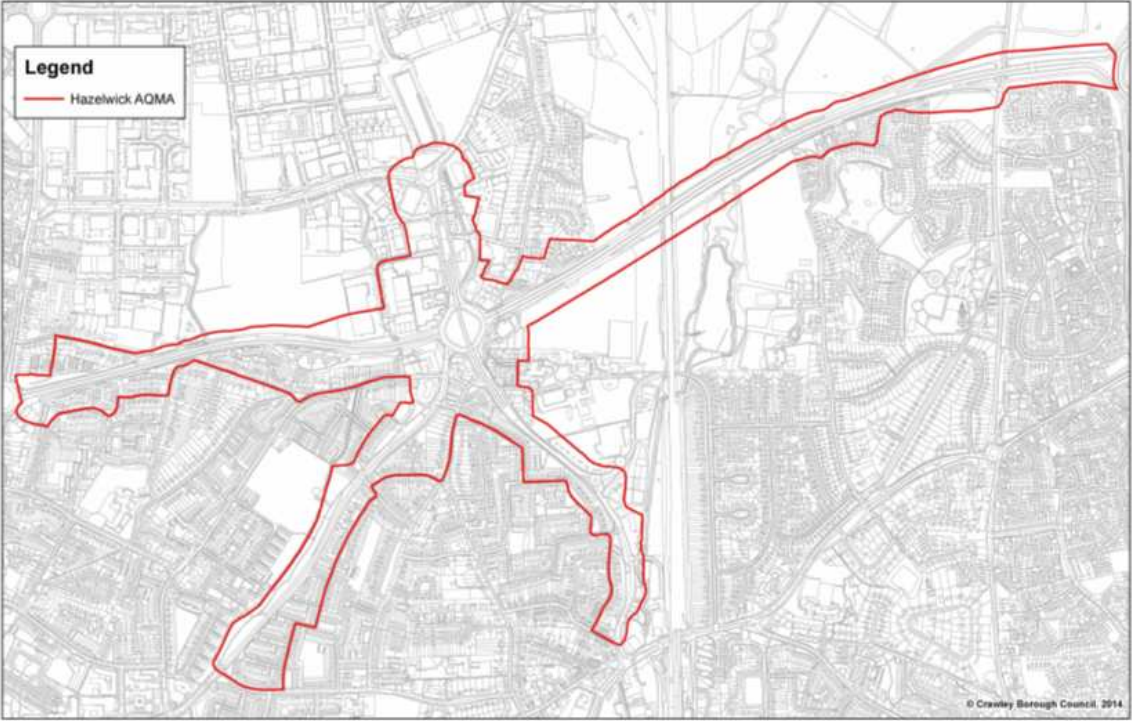
Unfortunately, since 2015, rather than shrinking away, the size of the AQMA has continued to grow, increasingly impacting parts of Pound Hill, Three Bridges, Northgate, and Langley Green.
Is there a risk to living within an AQMA? Well, from memory the guidance we issued at the time was that people shouldn’t spent long periods in their gardens (interestingly, it’s motorists who ultimately end up breathing in the most pollution, as the lack of ventilation in cars results in increasing concentrations of particulate matter). That seems pretty serious, but much like the frog in a pot of water on a stove, we don’t tend to notice the increasing risk until it’s too late to do anything about it.
The problem we face is that there isn’t actually much you can do to improve air quality along roads. There have been efforts to improve the flow of traffic through the area, as static traffic generates greater volumes of emissions, but ultimately any new capacity created tends to be taken up my more vehicles. Attempts at introducing better public transport, bike and pedestrian connectivity have all been rolled out (often in the face of more political and public objection), but again have had a limited effect given the scale of the problem. Ultimately, until there are fewer cars emitting particulate matter such as nitrous oxide, air quality in Crawley is going to get worse. That is the local context to Rishi Sunak’s decision to push back the deadline on new petrol and diesel car sales this week.
We have heard much about the fact that the Government’s own modelling shows that it will overall be cheaper for people to opt for electric vehicles by 2030, that the clear response of business leaders is that having a chaotic approach to net zero is damaging for their companies and has a negative effect on investment in UK PLC, and that the impact of global heating upon people living across the world proves that we can’t accord to slow down. Yet, even if none of this were true, Sunak’s decision means that here in Crawley we will continue to be inhaling toxic levels of air pollution for years to come, with none of us knowing quite when that risk will show up in the result of a biopsy.
Discover more from Peter Lamb for Crawley
Subscribe to get the latest posts sent to your email.
 Peter Lamb for Crawley
2 Comments