A few weeks back I came across a new tool produced by Friends of the Earth assessing the environmental performance of every local authority area by a series of metrics, how that performance compares against similar types of local authority area (for Crawley, the Office for National Statistics defines these as being Peterborough, Swindon, Thurrock, and Watford–the only other district-tier authority of the group), and how that ranks in comparison to the UK’s 2030 targets.

Each petal represents an area of performance which can then be expanded into its underlying measures. Despite being billed as an assessment of environmental performance, several of these metrics actually appear to relate to social issues, but I think we can forgive that given that they are things most people would consider to be worthwhile areas of focus.

While transport policy in Crawley is ultimately a West Sussex County Council responsibility and heath policy is controlled by the local NHS, housing is an area where Crawley Borough Council takes the lead. It also happens to be the town’s top-rated policy area. Rather surprisingly this includes household waste, as our recycling rates are poor by national standards, but given that the overall levels of waste produced per household in Crawley are amongst the lowest in the country when considering the overall environmental impact it may well be that we are one of the best performing areas.
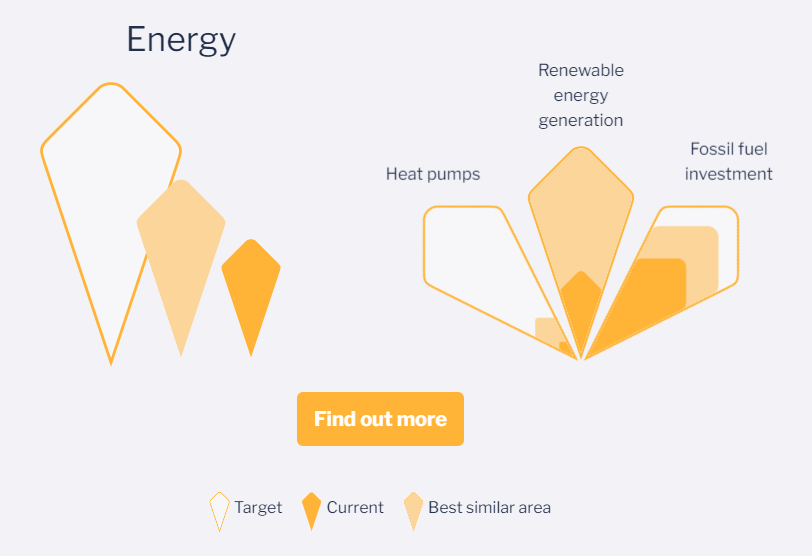
Meanwhile, the town’s worst area of performance is around energy, with renewable energy generation being the metric which really sets the town back compared to its statistical comparators.
There are several explanations for this. The first is that other than Watford, which ranks lower on renewable energy generation than Crawley, the other councils all have large rural hinterlands available for creating wind and solar energy generation. The second is that while Thurrock has on paper hit their target for renewables generation, given what we now know about the level of fraud involved in their solar farm investments, who knows what their actual figures really are.
A lot of work has been done to determine how we can generate renewable energy in Crawley. We have already rolled out solar on a number of council houses and properties, we have a district energy centre in the town centre, we are in the process of getting a renewables scheme rolled out across Manor Royal, a planning application for a solar farm near Gatwick Airport is currently awaiting decision, and there have even been–now dropped–proposals for using ambient heat from Tilgate Lake. Unfortunately, without more space the options will always be more limited and more costly than those authorities with a rural hinterland.
Ultimately though, regardless of our relative performance or the challenges we face, the fact is that no local authority, not even those publicly lauded for their progress such as Stroud, comes close to achieving the UK’s overall 2030 target for their area. That’s not long away now, just six years, three months, and a couple of weeks.
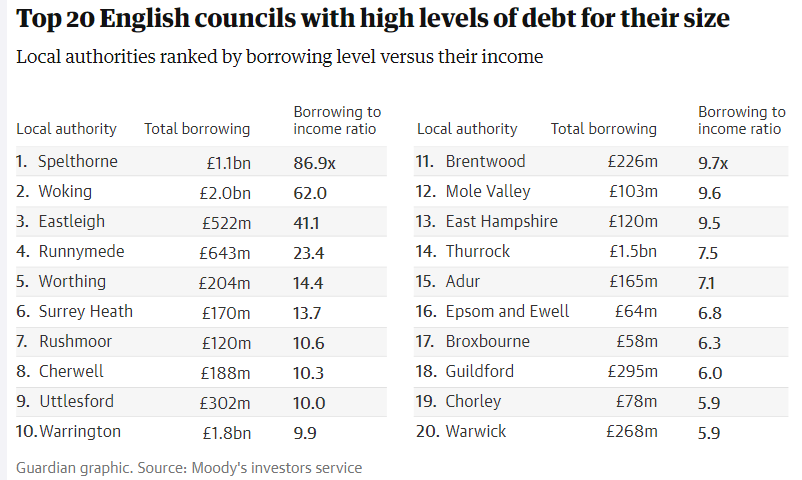
After a decade and a half of cuts, most councils are now struggling to find the funding to keep the lights on. At the same time they are facing simultaneous crises in housing, adult social care, and with deadly concrete. It is no wonder that with every passing year we see greater numbers of councils either declaring bankrupcy or teetering on the brink. There is simply no spare capacity left in the system to fund a capital programme on the scale now needed to hit those targets.
For all the pressure to bring councils’ net zero commitments forward, I know that many of the councils who have committed to being net zero by 2040 do not even have the resources in place to deliver it by the UK’s legally-binding deadline of 2050.
Frankly, even if the funding was in place, it is now too late for the vast majority of councils to hit the 2030 transitional targets. You can’t start these things from standing, you have to train the workforce and build the infrastructure for delivery. The question now is if 2050 is going to remain an achievable target, which scientists are clear is absolutely essential to avoid global catastrophe, we need a clear plan as to how local authorities will be able to fund the necessary works.
That doesn’t necessarily just mean the obvious route of grants or loans to local authorities from central government, but as the government sets all the restrictions on council funding and influences many of the demand pressures, there is simply no solution to this problem which can be found without the Treasury playing a major role.
Discover more from Peter Lamb for Crawley
Subscribe to get the latest posts sent to your email.
 Peter Lamb for Crawley