
By 2050, the UK needs to have hit Net Zero to meet our legal commitments, even if that’s far too late to avoid a much worse quality of life due to the impact of global heating.
Now that seems like a long way off, but let’s bear in mind that 26 years and four months is all the time we have to change every part of our homes, our lives, our economy over to creating no additional net carbon emissions. Really, it’s not that long at all.
There’s a big lead time too and that’s where the issue of electric vehicles comes in. The Government are now discussing pushing back the point at which new petrol and diesel cars can no longer be sold in the UK and understandably that’s causing concern about being being priced out of car ownership, with even the used car market becoming unaffordable.
However, the average age at scrappage of a car in the UK is now 14 years. Even if you sell your car on earlier than that, it’s still on the road emitting carbon. Now, if that’s the average age, so with the longevity of newer vehicles continuously increasing what percentage of vehicles do we think could still be running 20 years after sale? Every one of those vehicles still running in 2050 will need to be cancelled out by something reducing carbon emissions somewhere else. The more cars running the bigger this offset and the less likely it is to be achieved. It’s this lead time which is causing the changeover to feel so rushed.
On the other end of this lead time we have an issue with charging. Clearly being able to supply so many vehicles is challenging enough. Factor in that people will often want to charging their cars at the same time as other people (picture everyone getting home from work at 6pm, plugging in their car and the town’s power grid collapsing) and it gets worse. It gets even harder when you consider that hitting Net Zero means getting the power for the cars increasingly from renewable electricity generation, which unlike a gas/coal power station can’t be fired up quickly to match demand. Lastly, we already know from the National Grid that Crawley is effectively at the limit of what it can draw down on its current connection, and we have a major problem with how this is going to work in practice.
Still, getting power to Crawley is a problem for the National Grid to resolve. For local authorities, the lead time problem is trying to work out where residents can charge their cars.
This issue is one I was considering when looking at a recent data release from the House of Commons Library, outlining the number of electric vehicles and charging points within the constituency.
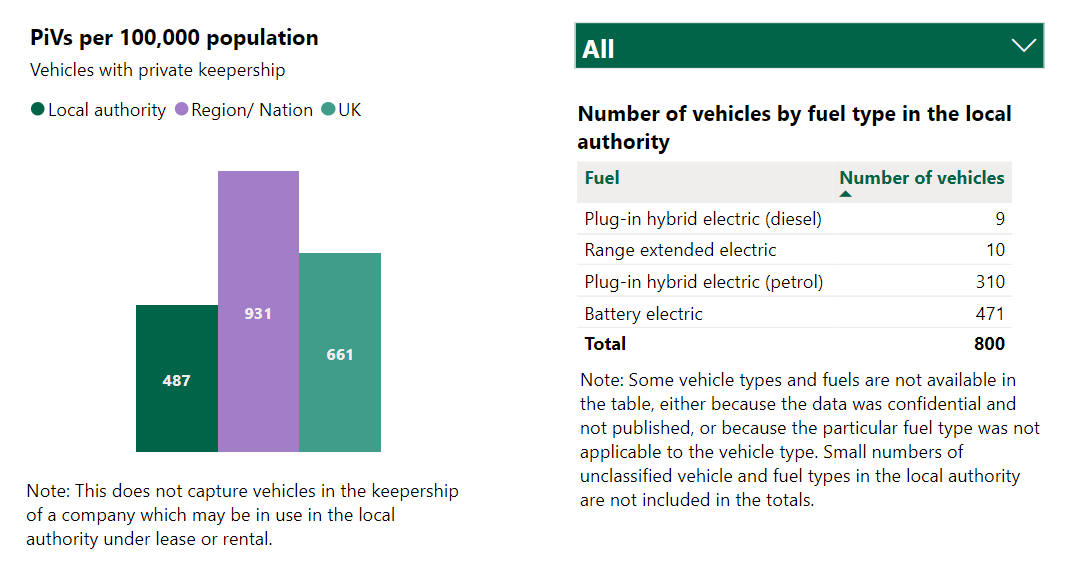
Crawley’s plug-in vehicle ownership is clearly on the low end, both nationally and regionally. We might seek to claim that the infrastructure for electric vehicles in the wider area or poor South East connectivity by public transport might be driving people to retain petrol and diesel cars, every one of the six local authorities surrounding Crawley have plug-in vehicle ownership exceeding not only the national, but the regional ownership.
It is far more likely that the issue here is economic. Electric vehicles are expensive to own and consequently have higher uptake in wealther communities. With incomes in the UK stagnant since 2008 (having failed to see the economy recovery experienced by every other country that didn’t opt for Austerity), it seems hard to believe that people are going to be any more financially fit to afford an EV in 2030 unless the prices drop substantially in the next six and a bit years. Certainly, a carrot in the form of a decent scrappage scheme outside of London, would be more likely to work in a town like ours than the stick the Government are currently proposing.
But, if there was a rapid adoption of EVs in Crawley, would we have enough places to charge them?
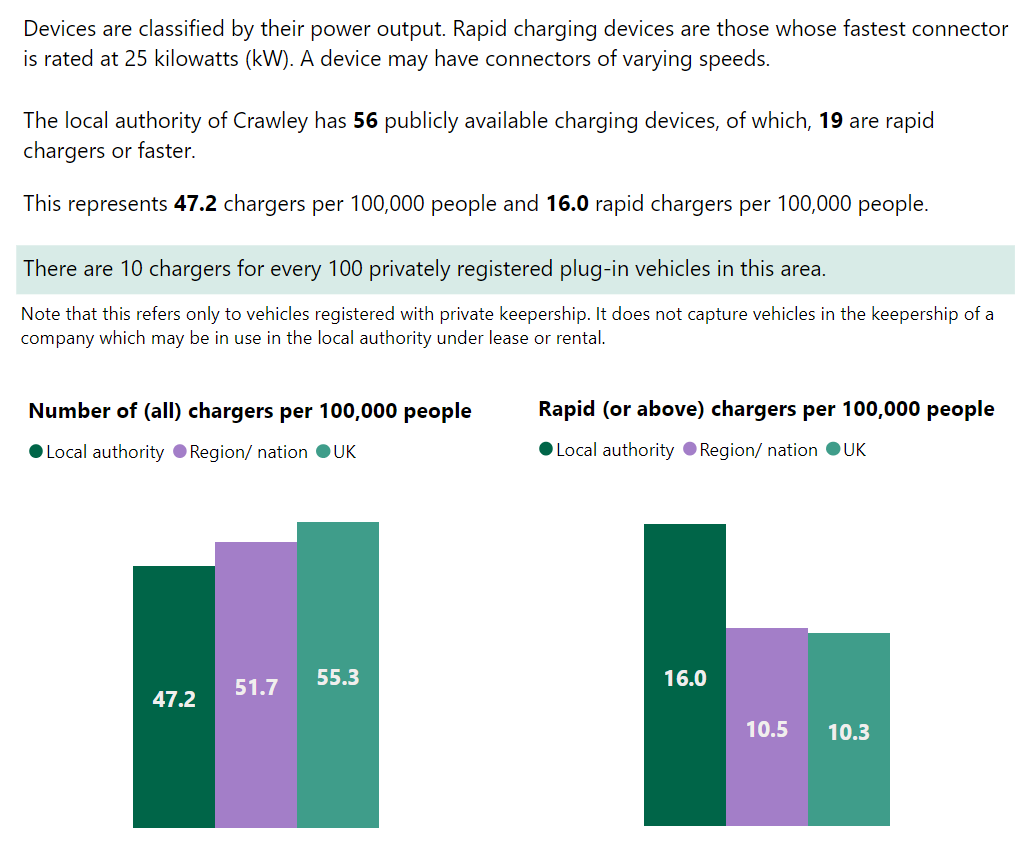
No, not really. While a disproportionate number of the chargers installed in Crawley are rapid chargers, even for the low number of plug-in vehicles we have a low number of chargers. Although, at least on this criteria we are actually quite far ahead of our neigbouring authorities, having rolled them out as part of various developments over the last two decades.
The problem is that in Crawley, we need public chargers more than those neighbouring areas do. Most people with electric vehicles currently charge them on their own driveway, which is fine if you have a driveway sufficient for the number of cars you own. Yet, as every Labour activist who has ever knocked a door in Crawley will tell you, when it comes to people’s local areas the number one issue across the town is parking and in its absence we need more places where people can charge their vehicles.
At this point, I should probably highlight that Crawley, along with districts and boroughs, is working with West Sussex County Council and a private partner to roll out charging points across the borough, including at council facilities and–more importantly–in residential areas.
As the two New Town neighbourhoods built first, West Green and Northgate were built not only without driveways but with minimal road space. I have heard it said that the planners at the time were of the belief that there would be average demand for one car for every ten houses. So, these are areas where there is both going to be the greatest future demand for public EV charging and where currently there are already the most accute parking problems.
So, it came as little surprise, that when EV charging points were proposed in a number of locations in my ward, they immediately started attracting large numbers of objections. Of course, who wants to lose another space when they are already struggling to find somewhere to park. The problem is, with big lead times to install the infrastructure, in a decade those same residents will be not only complaining that they can’t park, but they can’t find anywhere to charge their car.
Truth be told, while EVs are definitely part of the solution, I’m not convinced the infrastructure is going to be there to support electricity as the only means vehicle propulsion in a post-carbon society. Green combustion fuels would fit much better with our existing infrastructure, such as hydrogen. Of course, they come with their own challenges,
Discover more from Peter Lamb for Crawley
Subscribe to get the latest posts sent to your email.
 Peter Lamb for Crawley