
I recently came across a House of Commons Library data dashboard looking at armed forces statistics for every UK constituency, providing figures for the numbers of serving personnel, reservists and veterans for the town, with a map showing the proportions of veterans at the neighbourhood level.
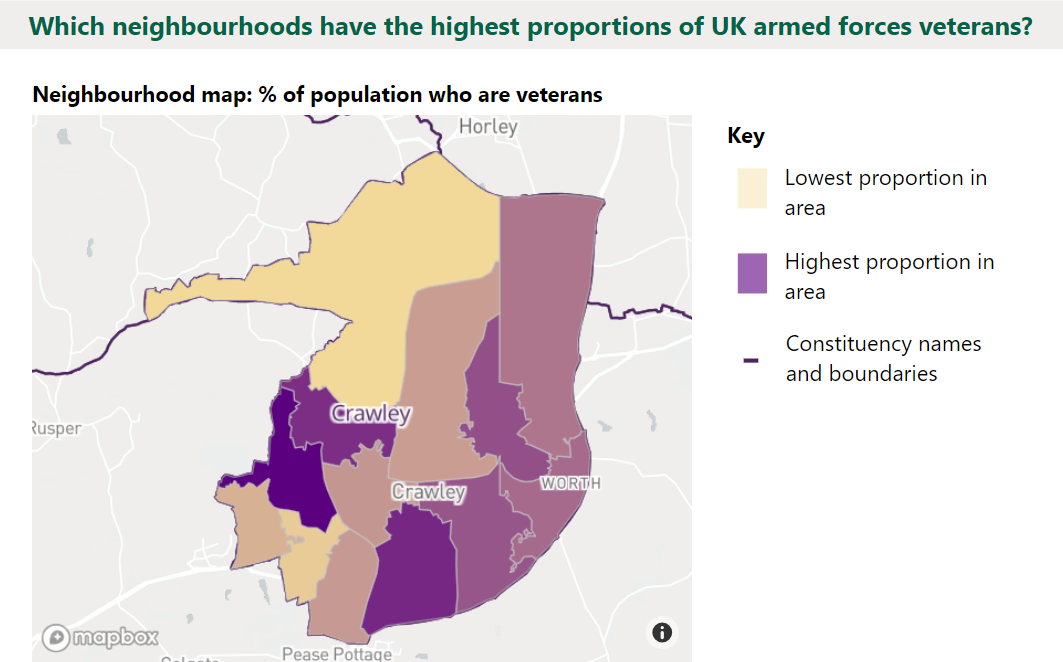
As ever, the neighbourhoods they use aren’t the town’s traditional neighbourhoods, but rather MSOAs. Units of roughly equal size built up from OAs (output areas), the Office for National Statistics’ most basic statistical unit of geography.
What the map shows is that the bulk of Ifield and Gossops Green has the highest concentration of veterans, followed by Tilgate, and West Green (plus the remainder of Ifield). Meanwhile, the lowest concentrations are in Langley Green and Broadfield North/East Bewbush.
So, what do we make of this? Whenever I see a data-overlayed map of Crawley, I start running through the options: what is the history of the neighbourhood, what types of housing does it contain, what infrastructure is there, and–most significantly–what’s the demography? It is in this last category that we find the answer.
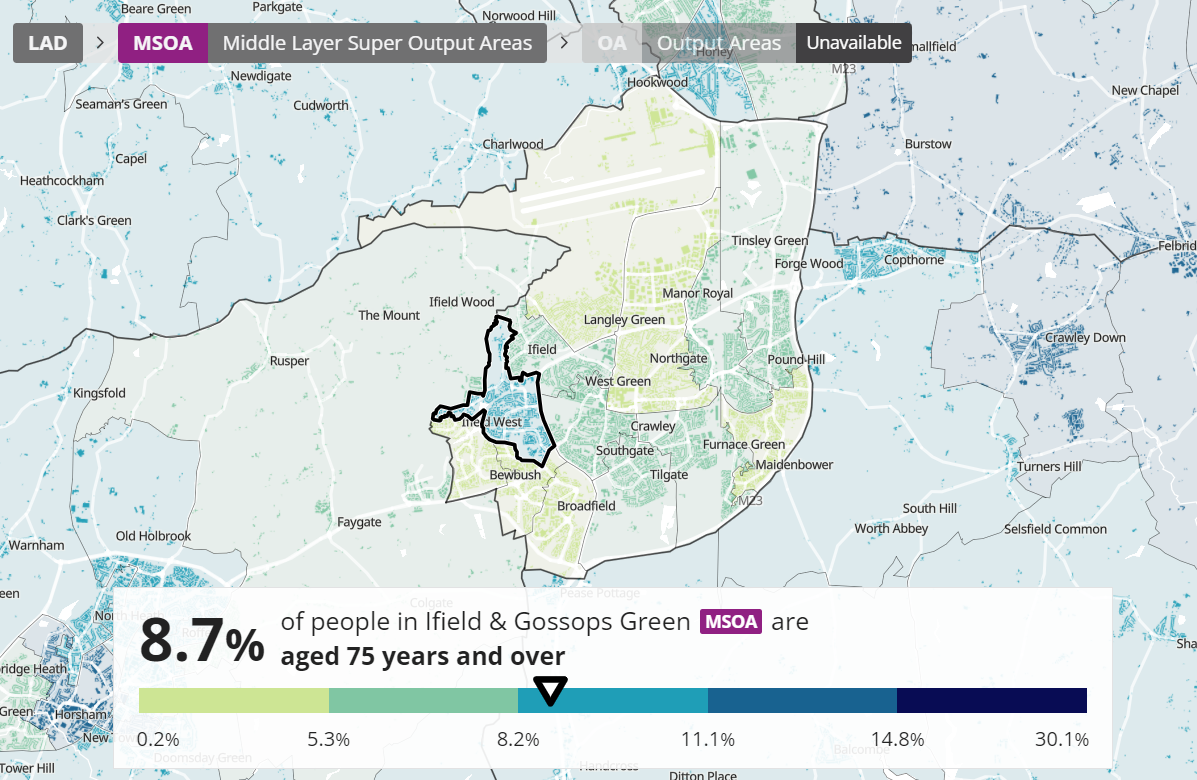
The answer is, of course, based around age. While a generation ago the cause of this would have the mass-mobilisation around WWII, that generation is unfortunately now all-but-gone with the youngest possible age for such a veteran being 94.
On the other hand, National Service continued until 1963, at which point the required ages were 17 to 21. Consequently, areas with a higher proportion of those aged 77 and above will tend to have the greatest concentration of veterans, regardless of any other factor. The three parts of Crawley highlighted as having the most veterans by the House of Commons Library data also happen to have the greatest proportions of those aged over 75.
Despite the number of National Service veterans diminishing over time, it seems likely that age will remain the best predictor of the numbers of veterans over the years, due to the decline in the size of the UK armed forces meaning that each passing generation contains fewer and fewer members who have served.
I do wonder how far this is likely to continue. We now seem to be watching the breakdown of the global order which emerged at the end of the Cold War (I don’t want to say peace, as states outside of the West did not enjoy the same respite from war), with the risk of conflict involving multiple major economic and miliary powers growing again.
The UK will not be immune to this and for all the faith in new techonology, as we have seen in Ukraine ultimately wars aren’t won by hypersonic missiles, drones and smart bombs, but by tanks, shells, and well-trained and motivated manpower.
Nonetheless, looking at the recently released Defence Command Paper Refresh it seems unlikely that this trend is likely to reversed any time soon, only being able to commit to maintaining ‘our force levels broadly at the levels announced in DCP21’. Whether that is viable for the long-term, only time will tell.
Discover more from Peter Lamb for Crawley
Subscribe to get the latest posts sent to your email.
 Peter Lamb for Crawley