
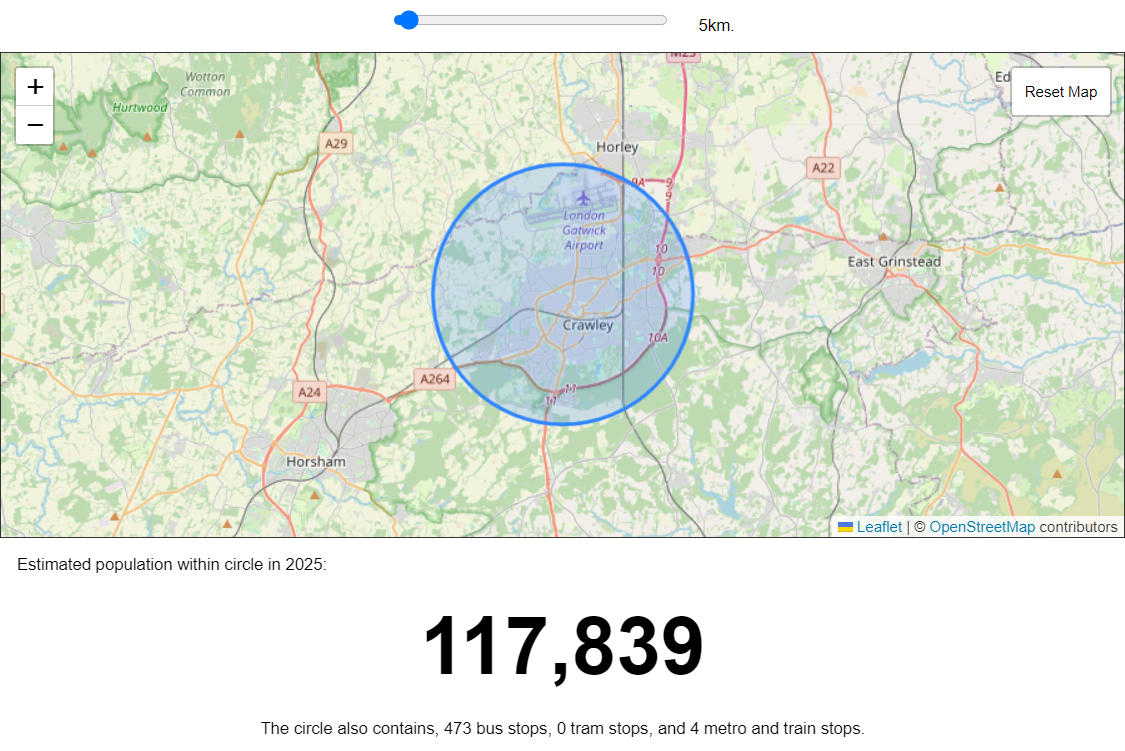
Amongst the various data apps Tom Forth periodically posts to Twitter was a tool for measuring the size of population within a circle around a point https://tomforth.co.uk/circlepopulations/.
So, at 5km around Crawley we essentially have the Census count for the town. At 20km we cover the Gatwick Diamond of Reigate in the North, Burgess Hill in the South, Horsham in the West and East Grinstead in the East and already have a population of 557,000. To put that into context, if that area were a city the only UK cities with larger populations would be London, Birmingham, Leeds and Glasgow. By 35km we’re now out to sea and cover a population of around 3m. Go to the maximum radius of 100km and despite around a third of the circle covering open sea you have almost a third of the UK’s population.
Now, 100km (62 miles) isn’t exactly the immediate vicinity of the town, but it’s not that far in the great scheme of things. It’s not so far that it is inconceivable for people to travel to work on a daily basis and a circle of that size around Crawley doesn’t even include the whole of Kent.
Now, is there a point to my raising this? Yes, it’s the same point which I regularly make when getting involved in debates around infrastructural investment.
The UK’s population is heavily concentrated within the South East. Even if you take out Greater London, despite a general absence of cities, the South East is the most populated part of the UK and it has an economy the same size of that of Greater London. Yet, any investment in infrastructure within the region tends to be focused either within London itself or on transport into and out of the city.
It makes no sense that the easiest route for accessing Tunbridge Wells by train from Three Bridges is via London Bridge or that a journey West across the region typically involves heading North to the M25.
Even on the smaller scale, the provision for the level of population and economic activity within the Gatwick Diamond, when it comes to acute hospitals, universities and major leisure and cultural facilities is a fraction of what an urban area would contain.
Unfortunately, much of this relates to the models of governance we have for these areas, which are not only fractured but where the loudest voices are typically more rural and generally opposed to any form of development. For a sub-region such as ours we need a single voice, concentrated in the areas of largest population. Only then will the area be able to clearly demand the investment it deserves.
Discover more from Peter Lamb for Crawley
Subscribe to get the latest posts sent to your email.
 Peter Lamb for Crawley