
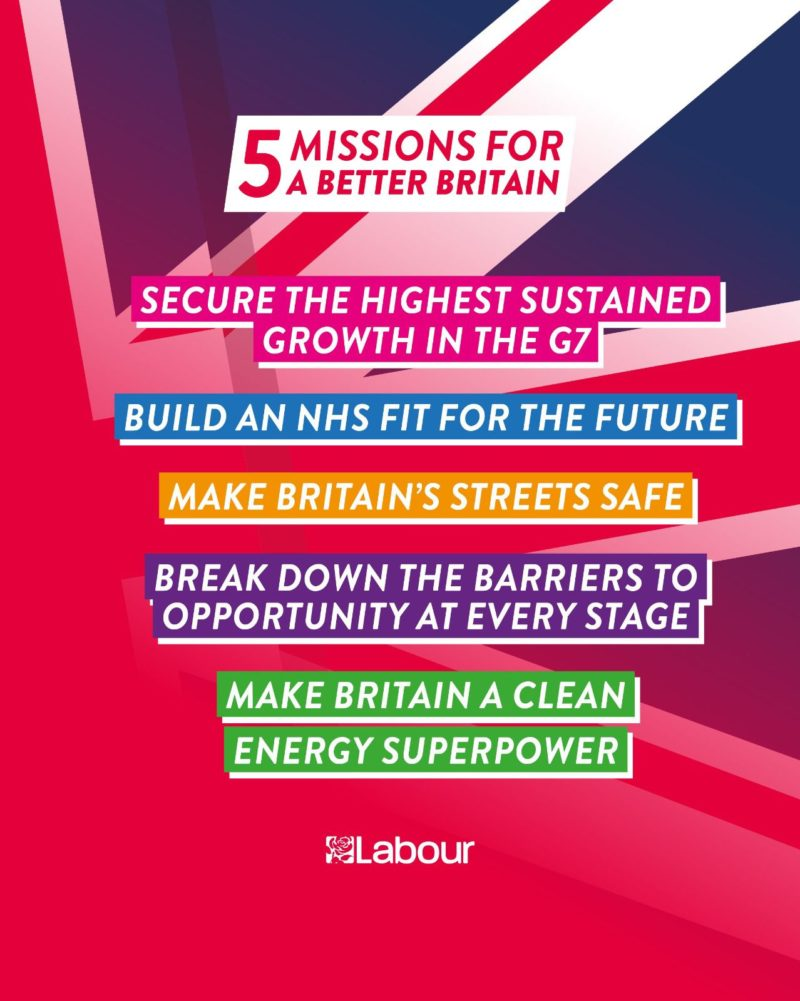
A few weeks back, Labour unveiled our ‘5 Missions for a Better Britain’, the first of which being the highest sustained growth in the G7. To say that’s ambitious is a massive understatement, the UK has seen next to no growth for 15 years now and has very rarely topped the table. With the current structural problems we face post-Brexit it would be remarkable to reach such levels of growth and yet it’s hard to see a solution to falling living standards or public sector funding which isn’t directly connected to getting out of the economic stagnation in which the banking crisis, followed by austerity, followed by Brexit, followed by COVID, followed by Liz Truss has trapped the UK.
However, that’s not what I’m writing about today, rather it’s the reaction I’ve seen from some quarters that this target isn’t just difficult, it’s not even desirable. Of course, this view isn’t something which has suddenly emerged from nowhere, rather there are those who have consistently been arguing for ‘zero growth’ for some time, their argument being that since resources are finite, growth must also be finite.
On the surface this feels self-evident, yet there are a number of parts which I’m not sure really hold up to scrutiny. Firstly, who is to say that the level of economic activity we have now is the ‘right’ level of activity? Certainly, from a perspective of carbon emissions our economic activity is far higher than what is sustainable, so do we actually need sustained recession with all the social consequences involved. Or, could it be that, like with many water systems, there are limits but we’re not quite at capacity yet and consequently can grow, so long as we exercise care? We know from psychology that people tend to default to believing whatever is currently the case is probably about the right level for any given variable, so it feels very coincidental that we are apparently at exactly the right point for growth to cease.
Secondly, what about the consequences of ceasing growth now? It is all well and good for fairly well off people in one of the world’s biggest economies to try to turn off the tap now, but the people who bear the consequences are typically those without a voice in the room. Something the late, great Hans Rosling deconstructed very effectively in one of his fantastic TED talks.
When the level of production is fixed it also has distributional consequences. For instance, with a fixed limit upon our total output, any new thing we need to produce will require us to reduce the production of something else. To an extent that already happens, with demand dropping for that initial thing as an improved alternative comes along to replace it, but it will be much more marked when no new growth can ever pick up the slack (raising the question of who will regulate it, presumably we will need to reintroduce some form of rationing).
The other distributional aspect is what this means in terms of inequality. While most improvement in global poverty over the last century has been driven by enabling development in poorer countries rather than relocating wealth directly, in the future people will only ever be able to improve their lot by taking it from others. As a socialist, I would like to see a more equal society, but doing so with zero growth makes civil unrest and international conflict seem inevitable.
Worse, while the global population is on course to stabilise, as people are still aging we haven’t yet hit peak planetary population of 10 billion yet. With economic output fixed at what we currently produce for a population of 7 billion, we’re going to struggle to ensure everyone has enough to meet even their most basic needs and ensure that 3 billion new people contribute no overall increase in economic output.
Even worse than that, ironically, would be the consequences of zero growth for the environment, for reasons I will explain in due course.
The root of the problem here seems to me to be a failure to understand exactly what economic growth actually is. Clearly, if the economy is just a machine which takes finite resources and consumes them at an increasingly fast rate then that won’t be sustainable, but that’s really not what we’re talking about here.
Economic growth is simply an increase in the total real value of all goods and services produced within a given system. While growth means that we’re producing greater value, that doesn’t necessarily mean that we’re experiencing unsustainable consumption.
For example, the first mass market automobile was the Ford Model T, which managed 25 miles to the gallon, but today the average UK driver manages 39mpg, with more efficient cars/drivers managing up to 60mpg. This improvement in the efficiency of technology is replicated throughout the economy over time, in fact there’s a major incentive for companies to do so in order to realise the savings involved from reducing their demand for resources.
A more extreme example of this can be found in the creative industries, considered to be the biggest growth sector of the future. The resources involved in producing a computer game, a movie or an album are huge, but once the first copy has been produced the cost of the second one is almost zero, you can literally produce as many digital copies of each as you want with almost no marginal increase in resources, meanwhile every copy contributes to economic growth. Obviously, the initial cost in terms of resources needs to be divided between each copy, but the point is that the increase in access to goods doesn’t necessarily have a linear relationship with resources consumed.
Furthermore, where resources are needed, not every resource is unsustainable. For instance, at a very basic level, so long as you grow equivalent amounts of lumber as you cut it down, you’re operating almost a closed loop in terms of that particular resource (obviously there are other factors in terms of processing and transport where the energy costs would need to be accounted for).
So, ‘no’ economic growth doesn’t necessarily require more resource usage, in fact you could theoretically decrease the overall use of resources while maintaining high levels of economic growth.
Clearly we are going to need to reduce our exploitation of some resources, but to return to my earlier point, there will be no way of achieving net zero by 2050 without massive economic growth. Carbon currently plays a fundamental role in our economy, if you reduce the size of that economy you can reduce the emissions, but you don’t totally remove them until all economic activity ceases.
Reaching net zero requires a fundamental shift in the way our economy operates, making major changes to our electricity network, to every building, and to our whole transport system, to name just a few areas. There will be few parts of the human world free from needing a physical transformation to either reduce its the need for an external energy source or to shift it over to a green electrical source. Outside of a world war, there will never have been such a huge shift required in our economy and the level of activity required to achieve it necessitates a step-change in our economic output.
Were we to try to make these changes without economic growth, we would lack sufficient remaining productive capacity to ensure basic human needs were met and since no one would be prepared to put up with that, net zero would effectively be off the table. Simply put: we need record economic growth in order to be sustainable.
Discover more from Peter Lamb for Crawley
Subscribe to get the latest posts sent to your email.
 Peter Lamb for Crawley