Today is Crawley Borough Council’s Budget Meeting (free for all to attend, from 7.30pm in the new Town Hall). It will be an interesting experience for me, having stepped down as Council Leader last May this will be the first budget in over a decade which I have neither been directly responsible for producing or for delivering the official Labour response.
As I wrote in relation to to WSCC’s budget last week, the settlement for local government as a whole was broadly designed to be in-line with inflation–just to reiterate though that the Government’s requires councils to put their tax up by the maximum amount in order for their figures to work out, but county councils have received an above inflation increase paid out of the share of district councils, like Crawley.
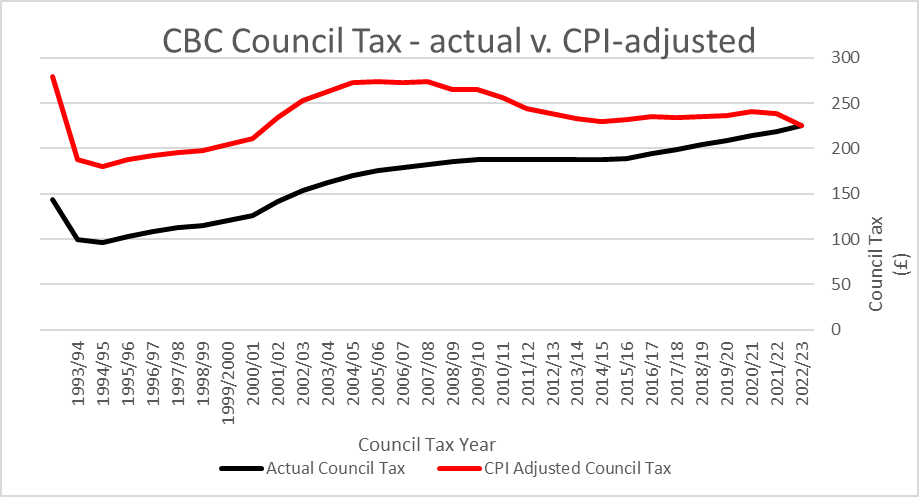
Despite this Crawley Borough Council will be putting its share of council tax up by 2.99%, substantially below inflation. In fact, in real-terms Crawley Borough Council’s council tax will in real-terms be its lowest for over several decades:
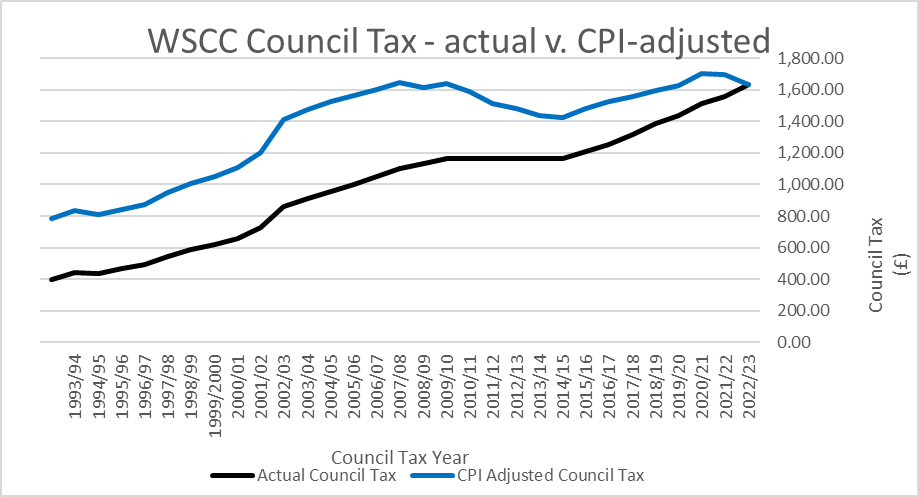
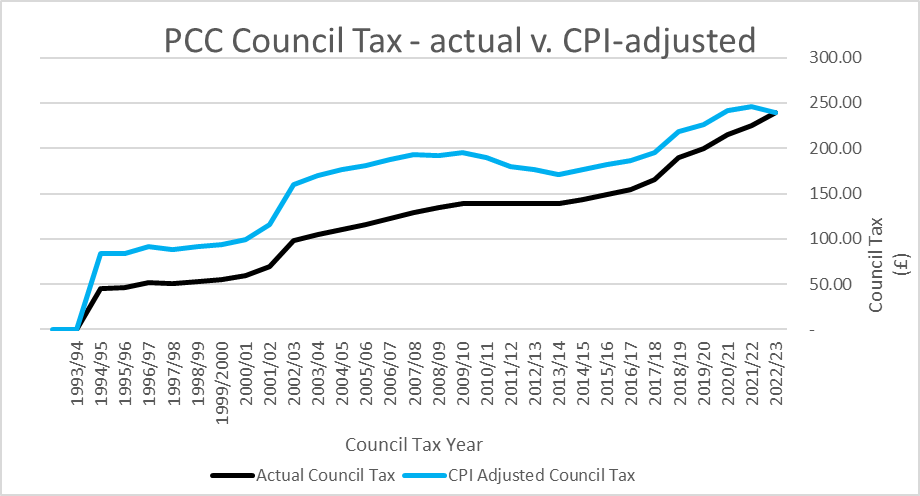
Unfortunately, the same cannot be said for the two Conservative-run authorities in our area: West Sussex County Council (who receive 77.83% of Crawley’s council tax) and the Sussex Police and Crime Commissioner (who receives 11.43% of Crawley’s council tax), whose tax increases have pretty consistently exceeded inflation:
While the inflation-resistance of Crawley’s council tax may come as a relief for residents at this difficult time, it does pose a challenge for the council. In cash-terms the borough council’s budget for services is around half of what it was at peak, if we then factor in inflation the budget is around a third of what it once was. Whenever I hear someone complain that something isn’t delivered in the way it used to be, I do reflect upon the fact that it’s remarkable with the budget we have that we’re able to continue delivering services at all.
Ultimately, the hope is that once things settle down with the economy, we will be able to go back to the approach Labour has had since we regained control of the council and focus on using our assets to derive new income streams. Certainly, alongside affordable housing resolving the council’s financial challenges was the key factor in deciding to build the new Town Hall, using the lower running costs and rental income from the office space above the council to plug the gaps caused by central government cuts.
There is every sign that this will happen, unfortunately much like everything else in the country, it does rely upon having a Government which isn’t entirely committed to economic self-harm and that may well require a General Election.
In the meantime, the council put money aside for much of my time as Leader to help cover the costs of economic turmoil and the time it would take to let the new building, so having only just taken possession of the building we’re still in the phase of drawing on this reserve. It won’t last indefinitely, but it does avoid the council rushing any financial decisions where a longer-term approach is likely to avoid losing much-valued services.
Alongside the budget for services, the council also has budgets for capital expenditure and for housing, the money for which comes from tenants and Right-to-Buy sales and which is legally restricted to housing-related expenditure.
The Government made much noise about capping the rate at which rents could be increased to well-below inflation. Given the challenges people are facing, this is understandable even if a little patronising given that Crawley has never increased rents as quickly as the Government has suggested in the past.
However, it’s worth being clear that the main beneficiary from the Chancellor’s decision is actually the Treasury, who through Housing Benefit (or the housing-component of Universal Credit) pay a vast percentage of social housing rents within the UK. Meanwhile, the main losers are those in the private-rented sector, who pay the full market rent (well above what a mortgage costs) and are seeing their rents go up above inflation.
The only money councils have to build new council housing comes from tenants rents and Right-to-Buy sales (which pay out less than it costs to build a new property), so a real-term cut in rents means that those in housing paying 50% of market value do get a cut in their rent, but those on housing waiting lists paying 100% of market value continue to see their rents go up above inflation. I think most people can do the maths on this one.
What the Chancellor of the Exchequer seems to have missed is that the Treasury also pays benefit out for large numbers renting privately, so while he can bank the short-term saving on social rents, in the longer-term he will be paying marked rents on private sector housing for further years when had we been able to build a council house the rent would have been half the level, saving the Government money. Still, who needs to think about the long-term when you’re only focused on the next election?
The Budget Meeting is usually one of the longer ones, because it’s one of the two biggest decisions we have to take as district-tier councillors. Unfortunately, the timings have worked out that tonight we will also be discussing the other most critical decision: the Local Plan, setting out how the town’s land will be used to meet all its needs for the next 15 years, a massively important document we have to run through every 5 years. If anyone is coming to the meeting tonight, it might be an idea to pack a thermos of coffee.
Discover more from Peter Lamb for Crawley
Subscribe to get the latest posts sent to your email.
 Peter Lamb for Crawley